





THE NETWORK
Extraordinary Commissioner of the Italian Government for Reconstruction, USR Marches Region, Municipality of San Ginesio, IPSIA (State Vocational High School) “R. Frau”
PROJECT DESCRIPTION AND CONTEXT
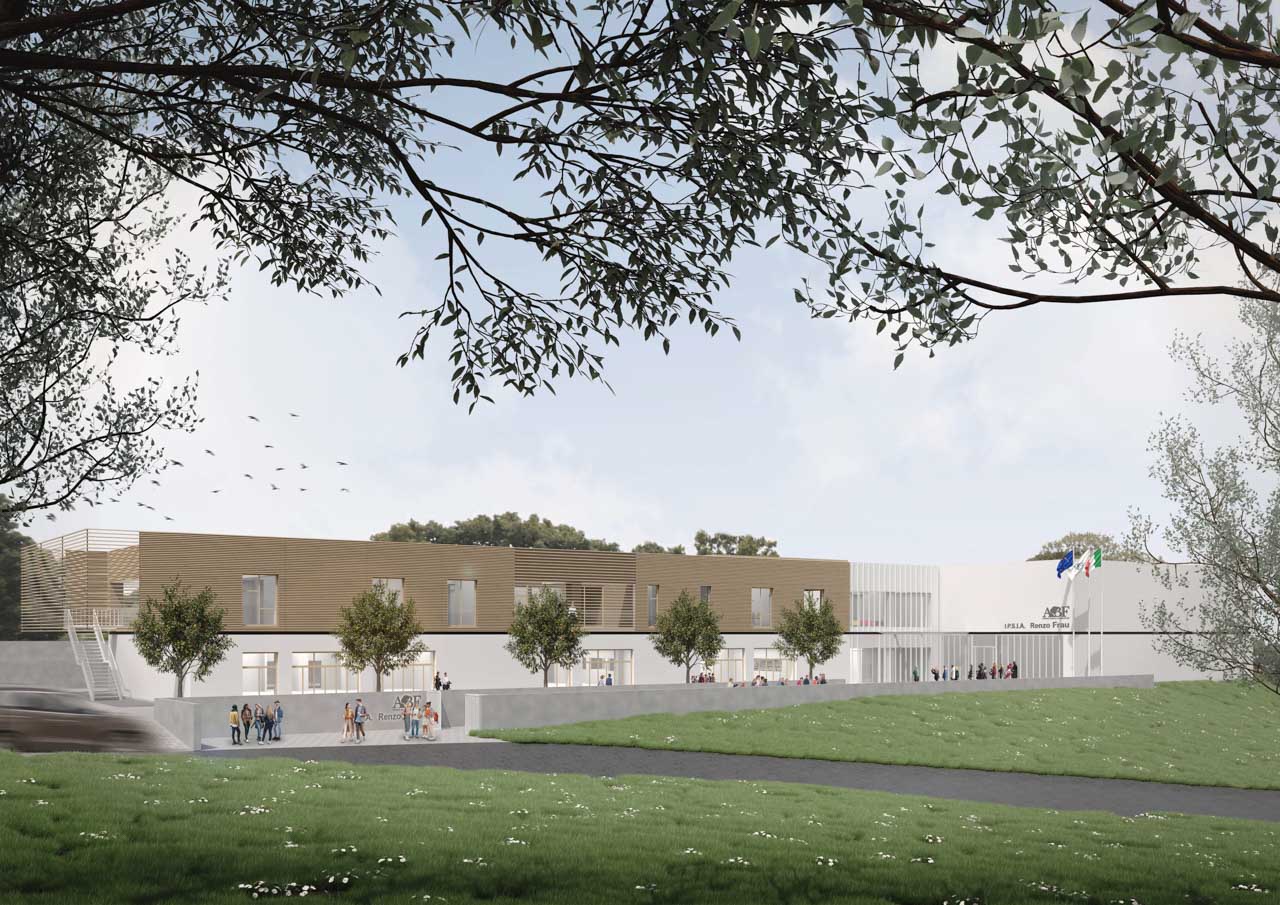
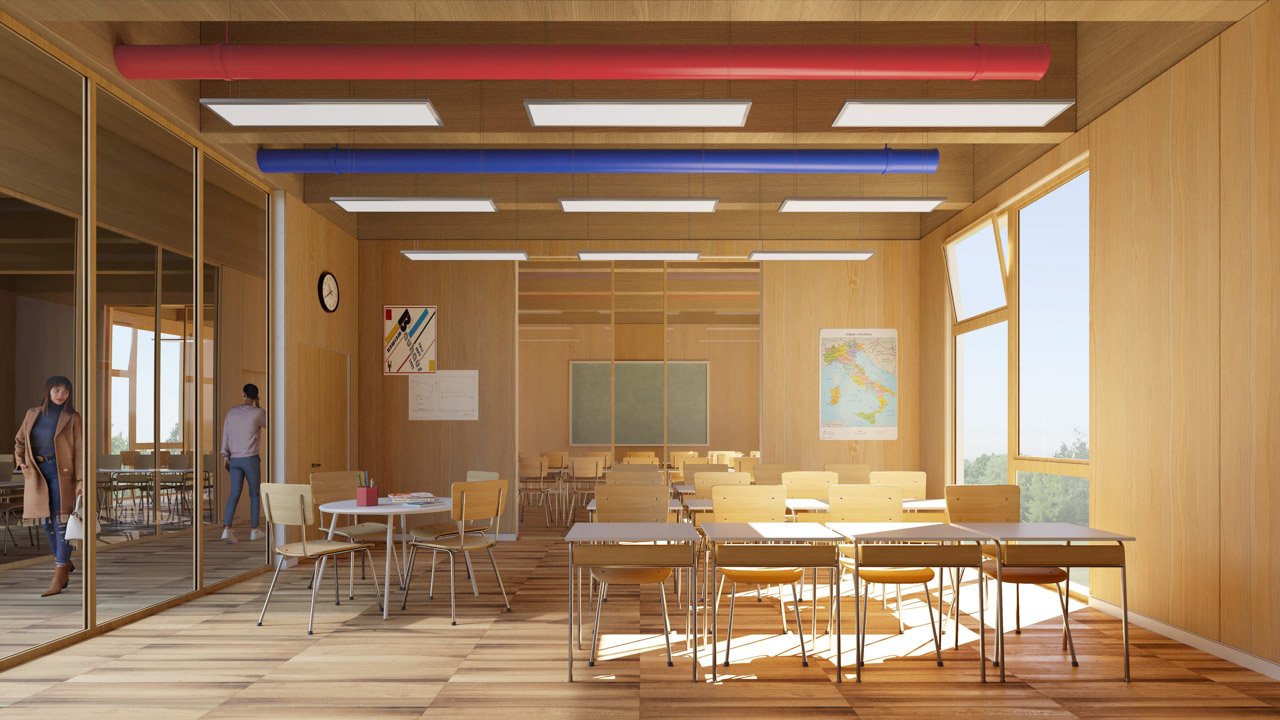
The San Ginesio project comes after the projects implemented in Sarnano, Muccia and Camerino, in the area of the 2016 earthquake epicentre; it represents a pilot at national level for a public/private collaboration that involves co-planning and co-design, all the way to co-execution. In order to implement the project, in fact, the Extraordinary Commissioner for Reconstruction after the 2016 Earthquake, Giovanni Legnini, issued Order no. 28 of 25/10/2021, published in the Official Gazette, in which, for the first time in our country, a third sector entity is entrusted with the design and project management of a 9 million public work built with commission resources.
For the first time a state decree also notes that a multidisciplinary team with expertise in architecture, engineering, youth education, budgeting & controlling, legal & institutional relations is required for the construction of a school.
The design was carried out by the multidisciplinary ABF team during 2022 and the construction site was handed over, after the ordinary tendering procedure, in January 2024.
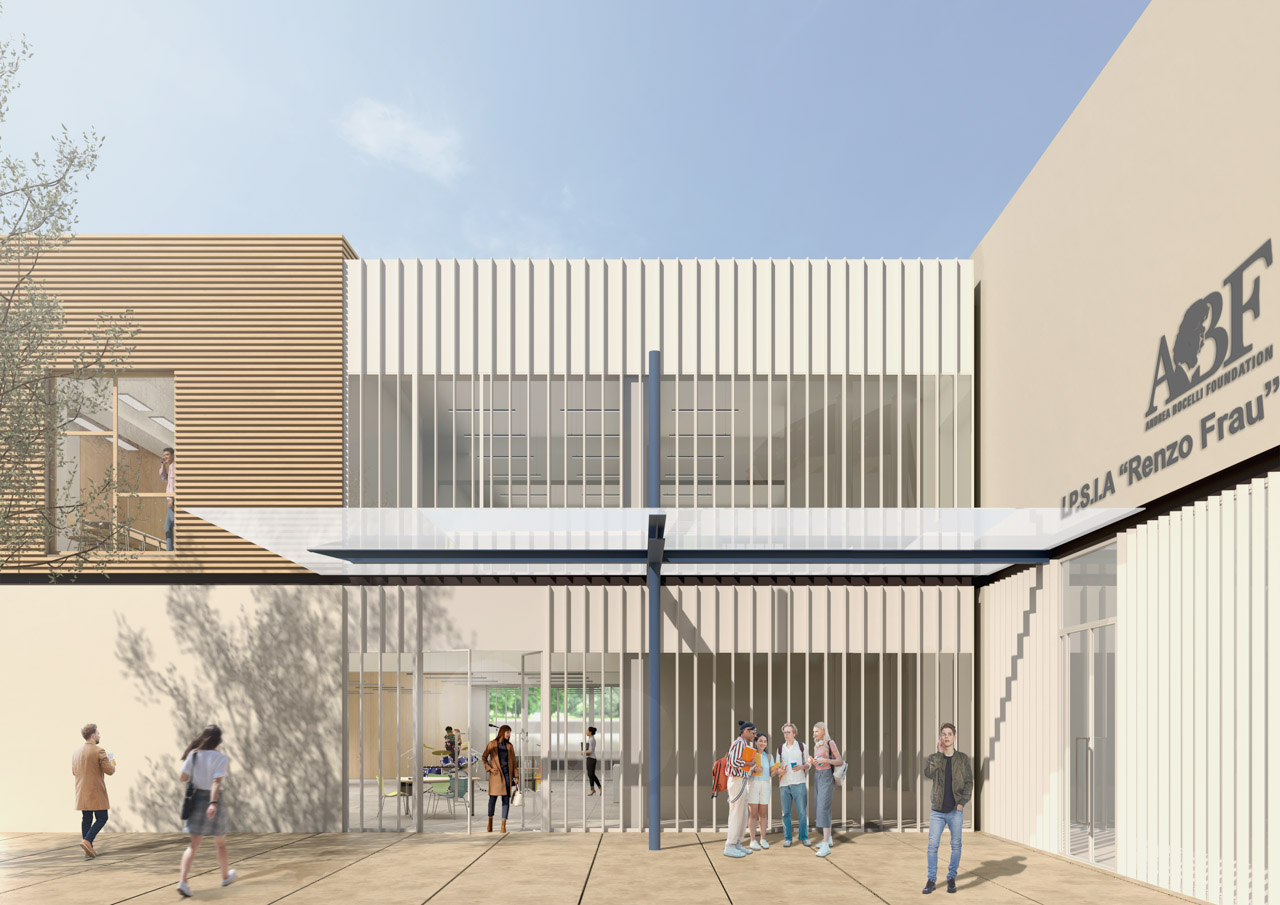
The careful planning process, in the design and aesthetics of the school, a building of approximately 2000 square metres, is aimed at revaluing the figure of the specialised worker as a key resource of “Made in Italy” and in particular for the development of quality companies in the area.
OBJECTIVES
- To provide a new safe and functional structure for students of the local area;
- To restore normal teaching activities;
- To reassess the figure of the specialised worker as a key resource for the development of quality small and medium-sized undertakings in Italy;
- To create an innovative public-private relationship model;
- To create tools (ABF Suite) to increase effectiveness and communication in the public-private relationship.
PERFORMANCE INDICATORS
| M.U. | 2023 | 2022 | |
| Direct beneficiaries | no. | 340,000 (epicentre inhabitants) | 340,000 (epicentre inhabitants) |
| Indirect beneficiaries | no. | 600 (families and teachers) | 600 (families and teachers) |
| Time of realisation | Days | Data not available | 345 |
| Degree of innovation | n/a | New IPSIA (State Vocational High School) organisation methodology | New IPSIA (State Vocational High School) organisation methodology |
| Degree of environmental sustainability | n/a | Using earthquake debris for concrete construction | Using earthquake debris for concrete construction |
PROJECT MANAGEMENT PROCESS
Stage 1: Identification of need based on the list (Commissioner’s Order no. 109 dated 23/12/2020 and no. 28 of 25/10/2021) provided by the Italian Government’s Extraordinary Commissioner for Reconstruction and the context analysis carried out through focus groups and interviews*;
Stage 2: Design by a multi-disciplinary team (education professionals, lawyers, architects, engineers, administrative staff) dealing with each stage of the design (preliminary, educational, final and executive);
Stage 3: Project execution is managed by ABF, in particular by the multidisciplinary team with strict attention to compliance with the project schedule and budget;
Stage 4: Evaluation using the indicators defined in the design stage;
Stage 5: Reporting through the “ABF Suite” platform, developed for the global design and management of real estate projects in Italy.
* The context analysis required to identify the needs of potential beneficiaries and the actions to be undertaken includes a preliminary study and in-depth analysis on:
· (It.) Ministerial Decree of 18 December 1975 on updated technical standards for school buildings;
· The Guidelines of INDIRE, the National Institute for Documentation on Educational Research Innovation;
· The Instructions of the document “Designing, building and inhabiting the school – Futura” of the (It.) Ministry of Education, also in the light of the National Recovery and Resilience Plan.
IMPACTS ON THE COMMUNITIES
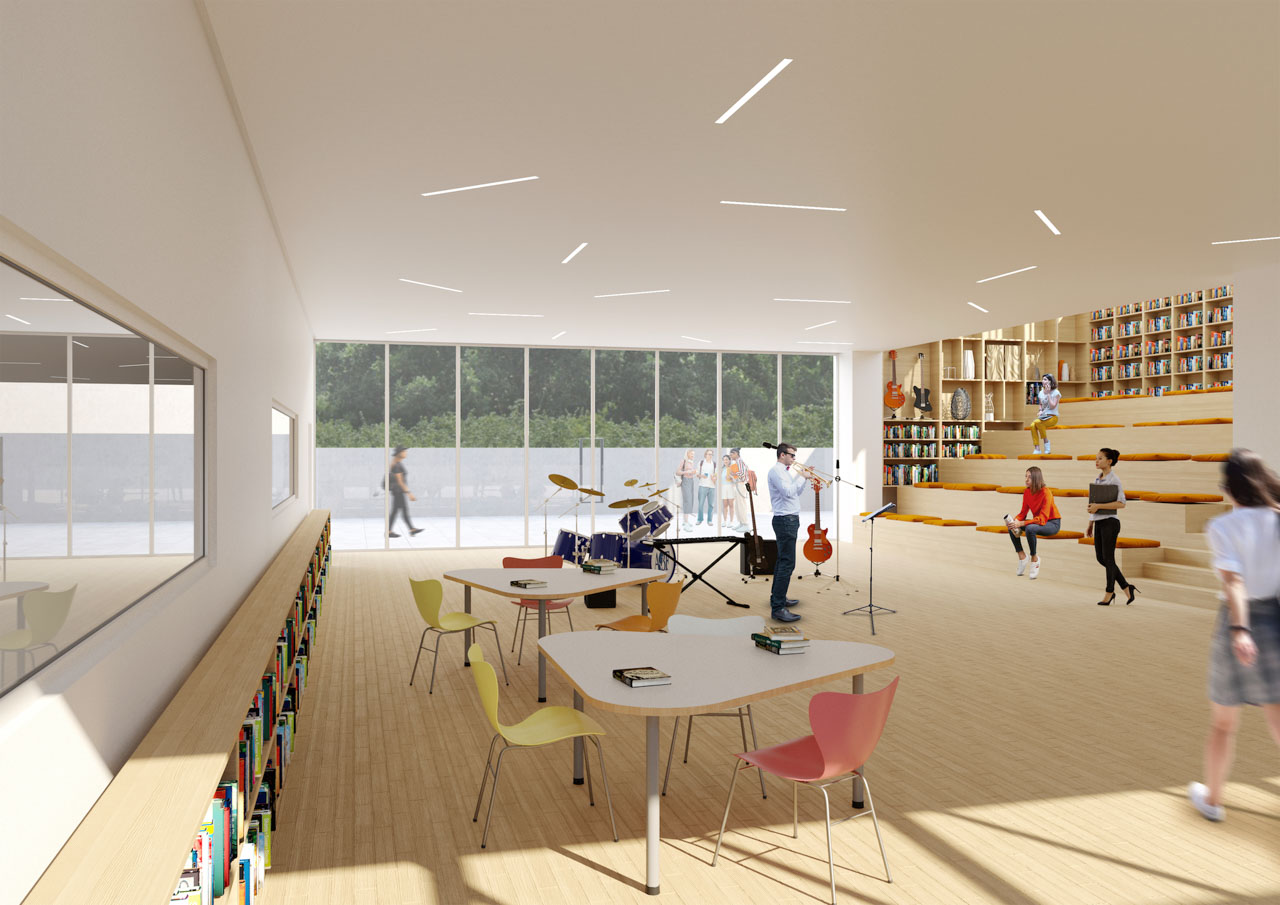
To restore opportunities for personal growth and thus economic and cultural development to the inhabitants of a town that had been deprived of them due to the 2016 earthquake, through the provision of functional and multifunctional physical spaces for the development of various project ideas. Furthermore, through the construction of the school, we can provide quality of educational offerings on a par with the best experiences nationwide, thus helping to avoid depopulation. Through the construction of the school, the productivity of both the school staff and the local associations that – together with the Foundation – will manage those spaces can be expressed and amplified.
Furthermore, by making such spaces accessible outside the school context, a place that creates aggregation and a sense of community will also be able to include the non-school population, giving the possibility of the creation of a social dimension that is not to be sought elsewhere.
At the induced level, the Foundation’s facilities can also generate an impact on the local economy because, in addition to being used during school hours, they are also used during extracurricular hours or during the summer, encouraging a flow of people (families, educational staff, donors, masterclass students and teachers, etc.) who make a positive impact on the local economy. This may give the local population the opportunity not to migrate to another country or region.


